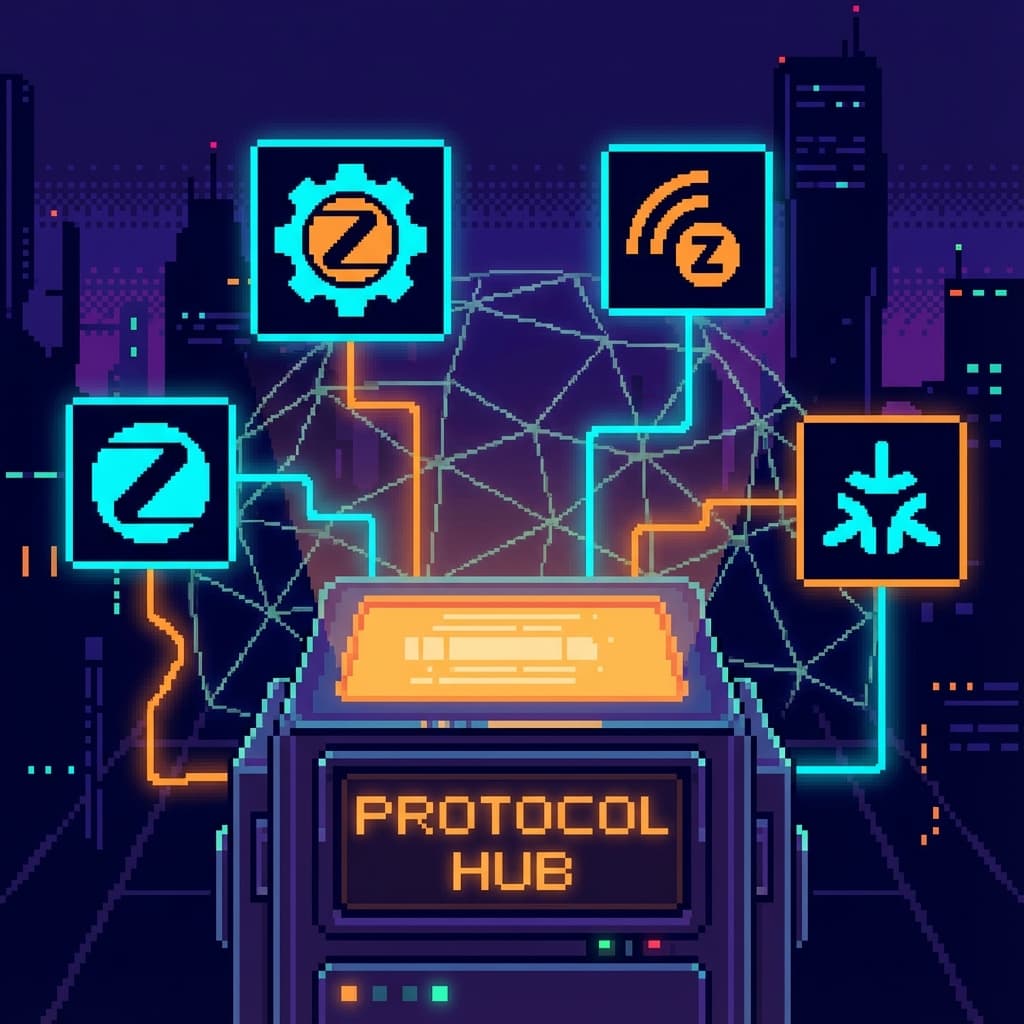
Okay, buckle up buttercups, because we're diving headfirst into the tech-tangle of Zigbee, Z-Wave, and the shiny new kid on the block, Matter! And, because I'm your friendly neighborhood Vibe Coder, we're gonna do it with a Nano Banana twist. Let's get this show on the road!
Alright, let's do this!
Key Takeaways
- The Big Shift: How Agentic AI is changing the game.
- Actionable Insight: Immediate steps to secure your AI Privacy.
- Future Proof: Why Local LLMs are the ultimate privacy shield.
1. THE COVER STORY: OpenAI Announced GPT-5.2 (Garlic)
Hold the Nano Bananas! According to reports, OpenAI dropped GPT-5.2, codenamed "Garlic," in December 2025 [1, 6, 8, 9]. It's supposed to be a serious upgrade for enterprise coding and agentic workflows [1]. The big deal? A massive 400,000-token context window and a 128,000-token output capacity – reportedly FIVE TIMES the context of GPT-4 [1]. Some sources are saying that "Garlic" was an internal codename for a parallel track of models distinct from the main GPT-5 line, and it was pulled out of a strategic reserve to restore balance after Google released Gemini 3 Pro [6, 8, 12].
Other sources claim that the model achieves near 100% accuracy on long-context understanding tasks, making it suitable for processing large documents and spreadsheets [8]. Also, it is rumored that the model achieved 100% on AIME 2025 without using external tools [6].
Pricing is around $1.75 per million input tokens and $14 per million output tokens [1, 9].
2. THE CREDENTIALS: AI Model Testing and AGI Certification – Are We Doomed?
So, you've got these AI models popping up left and right, claiming to be the bee's knees. But how do we really know if they're up to snuff? That's where AI model testing credentials and AGI (Artificial General Intelligence) certification come in. These certifications are designed to ensure that AI models meet standards for accuracy, fairness, transparency, and reliability [16].
Basically, it's about making sure AI isn't just some black box spitting out questionable answers. We need to be able to understand why it's making the decisions it is. As AI becomes more integrated into various industries, certifications will be key in ensuring responsible and effective deployment [16, 19, 20].
Are we victims? The jury's still out. On the one hand, these certifications can help protect us from biased or unreliable AI. On the other hand, who's in charge of setting these standards? And how do we prevent these certifications from becoming a barrier to entry for smaller players in the AI game? It's a tightrope walk, folks.
Join the Vibe Coder Resistance
Get the "Agentic AI Starter Kit" and weekly anti-hype patterns delivered to your inbox.
Join the Vibe Coder Resistance
Get the "Agentic AI Starter Kit" and weekly anti-hype patterns delivered to your inbox.
Join the Vibe Coder Resistance
Get the "Agentic AI Starter Kit" and weekly anti-hype patterns delivered to your inbox.
3. MIXTURE OF EXPERTS: We Are Firm Believers
Okay, picture this: instead of one giant brain trying to do everything, you've got a team of specialists. That's the basic idea behind Mixture of Experts (MoE) [2, 4, 14, 15].
MoE divides a model into multiple sub-networks or "experts," each trained to handle specific types of data or tasks. A "gating network" then decides which experts are best suited for each input [2, 3, 4]. It helps models with billions of parameters to reduce computation costs during pre-training and achieve faster performance during inference time [4].
Why are we firm believers? Because it's a way to scale AI without completely melting the planet's GPUs. MoE offers a way to manage the tradeoff between the greater capacity of larger models and the greater efficiency of smaller models [4]. We're betting big on this architecture.
4. HISTORY BLOCK: Fun History Section
Fun History Section
Did you know the Mixture of Experts concept was first introduced in 1991? That's right! The paper "Adaptive Mixture of Local Experts" by Robert Jacobs and Geoffrey Hinton proposed dividing tasks among smaller, specialized networks to reduce training times and computational requirements [2, 3, 4, 14]. Cut to today, and MoE is being used in some of the largest deep learning models [2]. AI history – let's make it a thing!
USE ARROW KEYS
5. THE VERDICT: Strategic Advice
Alright, so, Zigbee, Z-Wave, and Matter. What's the deal?
- Zigbee: Affordable and popular, but can have interference issues [5, 7, 10, 11]. It's good to try different devices in the same smart home [5, 11].
- Z-Wave: Reliable, secure, and good for working through walls, but can be more expensive and less widely available [5, 7, 11]. It is ideal for sophisticated, robust setups and offers an additional security layer [11].
- Matter: The new kid, aiming for interoperability. Still has some kinks to work out, but could be the future [5, 7, 10, 11]. It aims to simplify the buying process for smart devices and ensure they can communicate with each other, regardless of platform or ecosystem [11].
Strategic Advice:
- Consider your needs: Are you kitting out a small apartment or a sprawling mansion?
- Think about your existing ecosystem: Are you already invested in a particular smart home platform (Amazon Alexa, Google Home, etc.)?
- Don't be afraid to mix and match: A Matter bridge can allow devices using other protocols to work alongside Matter devices by translating between them [13].
- Future-proof where you can: Matter is gaining momentum and has the support of major players in the tech industry [5].
Ultimately, the best choice depends on your specific situation. Do your research, read reviews, and don't be afraid to experiment. And remember, the Vibe Coder is always here to help you navigate the tech-tangle!
Build Your Own Agentic AI?
Don't get left behind in the 2025 AI revolution. Join 15,000+ developers getting weekly code patterns.